

The AI Rights Project Introduces 'Human Baseline' Framework to Reanchor Law in the Age of Artificial Intelligence
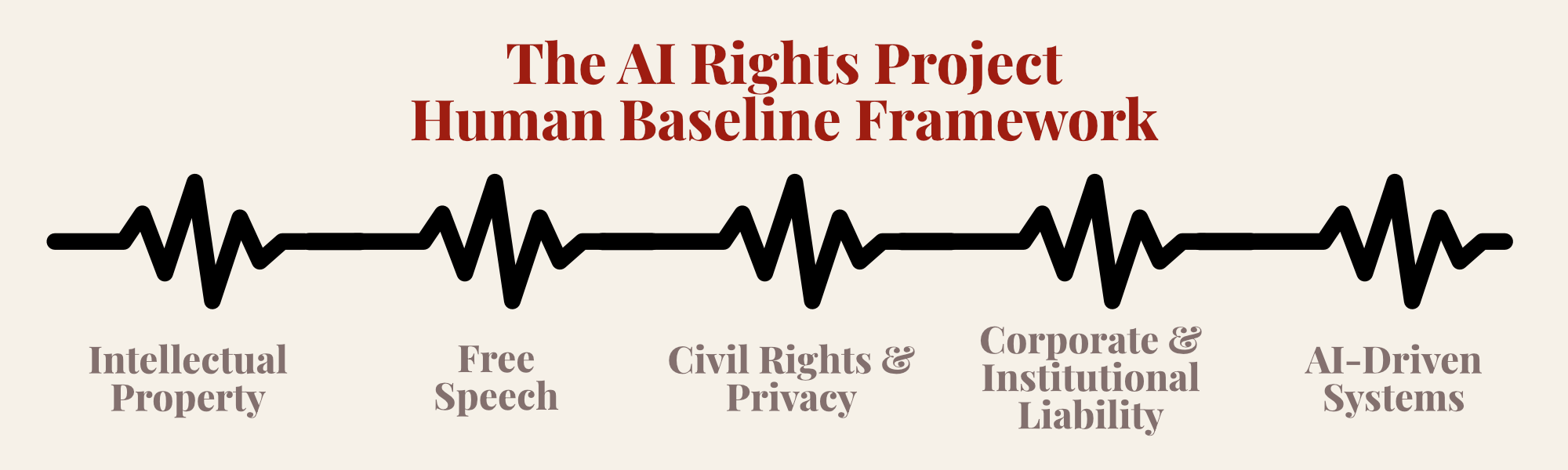
A legal interpretive framework preserving human judgment, accountability, and dignity as artificial intelligence expands human capabilities and reshapes the exercise of power across law and society.
The AI Rights Project, an independent, nonpartisan public-interest initiative dedicated to empowering students, creators, and citizens to better understand and assert their rights in the AI age.

Jim W. Ko, Founder & Executive Director, The AI Rights Project
New federal interpretive principle offers courts and Congress a human-centered alternative to AI pause and ban proposals
Modern legal systems developed in a world where human beings were the exclusive source of creativity, judgment, and decision-making. Even where law recognizes corporations or other legal persons, it has always presumed that humans originate decisions and can be held responsible for the harms those decisions cause. Legal rights, duties, and protections—from ownership to liability—are grounded in that foundational assumption.
Artificial intelligence disrupts this premise. AI systems now generate content, analyze information, make recommendations, and simulate human expression at scales and speeds no person could achieve alone. An individual or institution using AI can now exercise superhuman capabilities—creating vast quantities of expressive or technical material, influencing audiences at population scale, conducting surveillance or analysis beyond human limits, and coordinating action with unprecedented precision.
In many contexts, AI systems increasingly substitute for human judgment at the point of action.
Where Existing Law Is Breaking Down
As AI systems become embedded across society, long-standing legal frameworks built on pre-AI assumptions are beginning to falter in predictable ways:
• Intellectual property law struggles to distinguish human authorship and inventorship from machine-scale generation, threatening the meaning of originality and invention.
• Free speech frameworks are strained when AI-generated or AI-simulated content circulates without disclosure, blurring the line between human expression and synthetic influence.
• Civil rights and privacy protections weaken when automated surveillance and decision-making displace accountable human judgment, undermining individual dignity, due process, and contestability at institutional and population scale.
• Corporate and institutional liability rules falter when AI systems make consequential decisions without a clearly responsible human actor.
• AI-driven systems, particularly when deployed by dominant platforms, can concentrate power over markets, information, and behavior at a scale no individual or community can meaningfully challenge.
If left unaddressed, these gaps risk allowing power to be exercised through AI systems unencumbered by the limits of human capabilities around which existing law was designed—resulting in the gradual hollowing out of human-centered legal protections as an unintended consequence.
A Federal Interpretive Measure—Not an AI Ban
Rather than calling for an AI pause, model bans, or a new regulatory regime, the Human Baseline Framework proposes a federal interpretive principle—a default rule for how existing law should be read in AI-mediated contexts—that can be adopted within existing institutions.
Under this approach, absent clear and specific statutory authorization, federal law would be interpreted to preserve human-scale judgment, responsibility, and agency. Artificial intelligence may augment human capabilities when used as a tool under meaningful human control, but legal standards should not be recalibrated by default to assume, require, or defer to non-human cognitive capacities—or to permit the displacement of human creativity, discretion, or accountable decision-making.
The framework preserves Congress’s authority to authorize automated or non-human decision-making explicitly where it chooses to do so, while preventing such transformations from arising silently through implication or judicial inference.
A Foundational Reference for AI-Age Law
The AI Rights Project released the Human Baseline Framework as a public reference for courts, policymakers, civil society organizations, and the public. The framework is intended to help identify where AI-driven systems strain existing legal doctrines and to provide a common interpretive anchor for addressing those strains across domains.
The Human Baseline Framework also serves as the foundation for The AI Rights Project’s Know Your AI Rights™ eBook, which translates the framework’s principles into practical guidance for the public.
A forthcoming flagship paper will further develop the framework’s legal foundations and doctrinal implications for courts and lawmakers.
The full Human Baseline Framework: Reanchoring Law and Society in the Age of AI (v1.0) is available at:
https://airightsproject.org/human-baseline/
Additional Press Resources: For more press materials, organizational background, media contacts, and downloadable assets, visit the press and media page.
Jim W. Ko
The AI Rights Project
email us here
Visit us on social media:
LinkedIn
Bluesky
Legal Disclaimer:
EIN Presswire provides this news content "as is" without warranty of any kind. We do not accept any responsibility or liability for the accuracy, content, images, videos, licenses, completeness, legality, or reliability of the information contained in this article. If you have any complaints or copyright issues related to this article, kindly contact the author above.
